What Is Cervical Radiculopathy — and Why Cumberland County Patients Often Manage It Longer Than They Should

Cervical radiculopathy is the clinical syndrome produced when a nerve root in the cervical spine is compressed as it exits the spinal canal. The compression can come from a herniated disc — where nucleus pulposus material displaces and contacts the nerve — or from bone spur formation and foraminal narrowing driven by degenerative arthritis of the cervical joints. In both cases, symptoms follow the nerve's anatomical path: from the neck and shoulder into the arm, forearm, and hand, producing radiating pain, numbness, tingling, and in significant cases, weakness in the muscles the nerve supplies. The anatomical distribution is specific enough that an experienced examiner can identify the affected nerve level without imaging: C5 radiculopathy produces shoulder and outer arm symptoms with deltoid and biceps weakness; C6 affects the thumb and index finger with biceps reflex changes; C7 produces middle finger numbness and triceps involvement; C8 affects the ring and small fingers and grip strength. 

This specificity is the key to accurate diagnosis — and it requires a spine-trained clinician to apply it. Many Vineland-area patients who present at our office have been attributing their arm and hand symptoms to work-related strain — an assumption that makes intuitive sense for someone in a physically demanding occupation.

The problem is that work-related positioning can absolutely aggravate a cervical nerve root condition, but it does not cause the structural compression, and managing it as a soft tissue injury without identifying the nerve root source leads to prolonged, unnecessary symptoms.

Cervical Radiculopathy in a Working Population — What the Job Reveals and What It Obscures

Cumberland County's working population — agricultural workers, food production employees, tradespeople, and those in manufacturing and distribution — places particular demands on the cervical spine. Sustained overhead work, repetitive lifting with neck extension, vibration exposure, and prolonged postures at workstations all create conditions that can accelerate cervical degeneration and provoke nerve root symptoms in a spine that is already compressed. What this means clinically is that occupational loading can both trigger the onset of symptoms and mask their true source. A farmworker whose arm goes numb after a day of overhead picking may reasonably attribute it to the work — and may be partially right that the work is provoking a nerve root that would otherwise be asymptomatic. But the underlying structural compression is the diagnosis, and treating only the work modification without identifying and addressing the cervical source leaves the underlying problem unresolved. At our Vineland office, we take a careful occupational history as part of every cervical evaluation: what the patient does physically at work, which positions aggravate symptoms, whether symptoms are present at rest as well as during activity. This context shapes both the diagnosis and the treatment conversation — particularly when discussing recovery timelines and return-to-work planning for patients who cannot simply limit their physical activity indefinitely.

Background media

The Evaluation at Our Vineland Office

The clinical examination begins with a systematic assessment of each cervical nerve root level: testing dermatome sensation in the arm and hand, myotomal strength in the shoulder, elbow, wrist, and grip, and deep tendon reflexes at the biceps, brachioradialis, and triceps. We assess provocative maneuvers including Spurling's test — cervical extension and ipsilateral rotation that narrows the foramen and often reproduces the arm symptoms when cervical compression is the source.

MRI of the cervical spine provides the structural diagnosis: disc herniation, foraminal dimensions at each level, nerve root contact, and spinal cord status. When the clinical picture and MRI do not fully align — when imaging shows narrowing at multiple levels but the examination points to one — electrodiagnostic testing (EMG and nerve conduction velocity) resolves the ambiguity by showing which nerve root is actually dysfunctional. We use this testing selectively, not as a default step, but it is valuable when the clinical picture is genuinely uncertain.

The goal of evaluation is a specific diagnosis — not 'cervical spondylosis' as a catch-all, but a named nerve root at a named level with a named structural cause and a clear treatment recommendation to go with it.

Treatment: Conservative Management to Surgical Decompression

Conservative management is appropriate for the majority of cervical radiculopathy patients, particularly those with disc herniation of relatively recent onset. The natural history of disc herniation-driven radiculopathy is meaningful spontaneous improvement in many patients as the disc material resorbs over weeks to months. A structured course of physical therapy — cervical traction, manual therapy, nerve mobilization — combined with activity modification supports this natural process. For patients with significant nerve root inflammation, a targeted cervical epidural steroid injection can reduce acute symptoms and create a window for rehabilitation.

For Cumberland County patients who work in physically demanding jobs, we are specific about what conservative management requires: not complete work cessation in most cases, but modification of positions and activities that mechanically compress the affected foramen while recovery is underway. We build realistic, occupation-aware treatment plans rather than generic instructions that are impractical for the way these patients actually live and work.

When conservative management is not providing adequate improvement — typically at six to eight weeks with a structured program — or when progressive neurological weakness makes a longer conservative trial inadvisable, surgical decompression becomes appropriate. The surgical options, ACDF or posterior cervical foraminotomy, are chosen based on the anatomy and mechanism of compression, not by protocol.


Banner media

Your Surgical Team at POA Vineland

Rahul V. Shah

Dr. Rahul V. Shah, MD, FAAOS

Board-Certified Orthopaedic Spine Surgeon  |  Fellowship-Trained, UCSF  |  Chief Resident, Yale

Dr. Shah's commitment to the Vineland office reflects a principle he is direct about: the clinical standard does not change by geography. The UCSF spine fellowship training, the Yale chief residency, the evidence-based evaluation framework — those travel with the surgeon. Cumberland County patients receive exactly the same diagnostic rigor and surgical precision as patients at any other POA location. His approach to cervical radiculopathy in Vineland is the same as his approach anywhere: identify the specific nerve root, confirm the structural cause, be honest about what conservative management can accomplish and what it cannot, and make a surgical recommendation only when the anatomy and clinical picture together support it.

  • FAAOS — Fellow, American Academy of Orthopaedic Surgeons
  • Spine Surgery Fellowship — University of California, San Francisco
  • Chief Resident — Yale University Orthopaedic Surgery
  • Faculty — Rowan University Medical School

View Full Profile

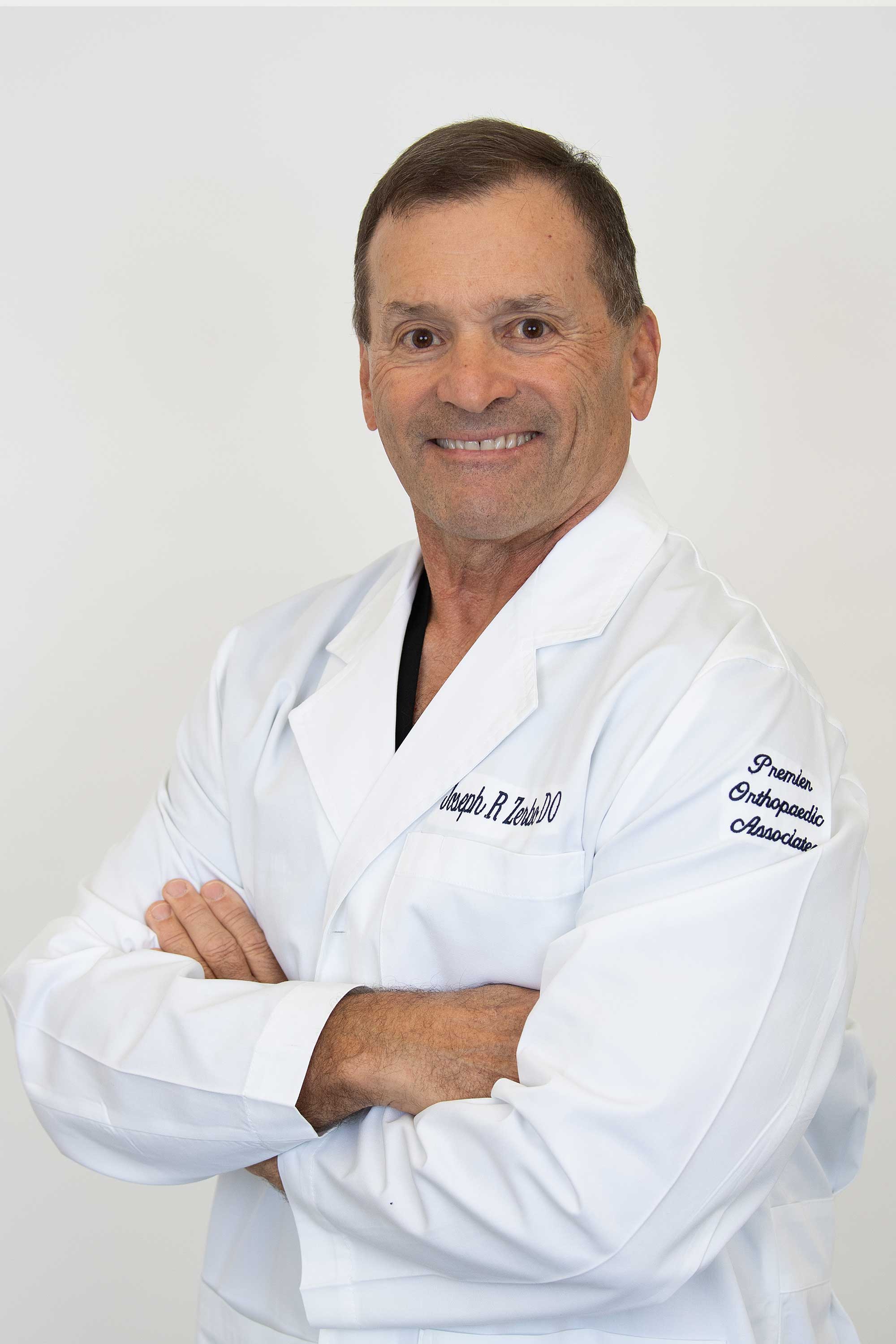
Joseph R. Zerbo male in white lab coat

Dr. Joseph R. Zerbo, DO

Board-Certified Orthopaedic Spine Surgeon  |  NASS Member  |  35+ Years in Southern NJ

Dr. Zerbo's D.O. training gives him a perspective on cervical radiculopathy that is particularly relevant for Vineland's working population. He does not evaluate the nerve root in isolation — he evaluates the patient who lives and works with that nerve root. How someone carries themselves through a physically demanding job, what their posture looks like after a long shift, how much their activity demands are contributing to their symptoms — these are part of the clinical picture, and they inform the treatment plan in practical ways. For patients who need to return to physical work after treatment, his honest, experience-based counsel about what is feasible and what the recovery arc looks like is grounded in decades of treating exactly this patient population in South Jersey.

  • AOBOS Board-Certified — American Osteopathic Board of Orthopaedic Surgeons
  • NASS Member — North American Spine Society (since 1999)
  • Chief Resident — Kennedy Memorial Hospital / UMDNJ
  • Founder — Zerbo Spine, PA

View Full Profile

Cervical Radiculopathy FAQs

I've been attributing my arm numbness to my job — how do I know if it's actually my cervical spine?

Do I have to drive to Philadelphia or Camden for this level of spine care?

I work a physically demanding job — what does conservative treatment actually require of me?

Is surgery the only option if conservative treatment doesn't work?

I've been attributing my arm numbness to my job — how do I know if it's actually my cervical spine?

Work positioning can provoke cervical nerve root symptoms, but it does not cause the structural compression that underlies cervical radiculopathy. If your arm numbness or pain follows a consistent pattern in your arm and hand — particularly if it follows the distribution of a specific nerve — and if it is present at rest as well as during work, a cervical nerve root evaluation is warranted. A structured clinical examination and cervical MRI can determine whether the source is in your neck or elsewhere. This distinction matters because treating it as a soft tissue work injury, when the source is actually a compressed nerve root, prolongs symptoms unnecessarily.

Do I have to drive to Philadelphia or Camden for this level of spine care?

No. That is precisely why the POA spine center operates in Vineland. The spine surgeons at our Vineland office bring fellowship-trained evaluation — Dr. Shah's UCSF spine fellowship, Dr. Zerbo's board certification and 35 years of experience — to Cumberland County. The same surgical capability and diagnostic rigor available at larger medical centers is available here, in Vineland, without the commute that has historically made specialist care inaccessible to much of this region.

I work a physically demanding job — what does conservative treatment actually require of me?

Conservative management does not mean stopping work entirely in most cases. It means modifying activities that place the cervical spine in positions that compress the affected foramen — prolonged neck extension, repetitive overhead reaching, sustained vibration exposure. We build specific, occupation-aware activity modifications into every conservative treatment plan so that recommendations are practical for how you actually work. We also set clear expectations: conservative management has a defined timeline, not an indefinite one, and if you are not improving within that window, we reassess rather than continuing to defer.

Is surgery the only option if conservative treatment doesn't work?

Surgery is the appropriate next step when conservative management has been reasonably completed without adequate improvement, particularly when neurological deficits are present. The surgical options are well-defined and highly effective for cervical radiculopathy — ACDF and posterior cervical foraminotomy both have very strong outcomes for appropriately selected patients. What we will never do is recommend surgery before the conservative trial has been given its appropriate window, or avoid surgery when the clinical picture clearly warrants it. The recommendation follows the evidence.

Premier Orthopaedic Associates Vineland

Contact

(856) 690-1616

Hours of Operation

MON — FRI: 8:30AM - 5PM

Contact This Location
Contact us media
Accessibility: If you are vision-impaired or have some other impairment covered by the Americans with Disabilities Act or a similar law, and you wish to discuss potential accommodations related to using this website, please contact our Accessibility Manager at (856) 690-1616.
How can I help you?

Hey there, how can I help you?

Schedule a Visit Find a Provider Bill Pay
Contact Us